Saturday, April 24, 2021

Responding to a Call

 Every month, I have the opportunity to speak on KMAN, a regional radio station in Northeast Kansas about work that's happening at the Institute for Civic Discourse and Democracy. During the last visit, I was asked about the recent guilty verdict in the Derek Chauvin trial following the murder of George Floyd. There were a couple callers with comments about the topic. This wasn't surprising and was, frankly, expected. With a listening audience covering quite a stretch of rural Kansas, the perspectives of most listeners go beyond the perceptions of what a college-town such as Manhattan might be. 

One caller followed up with an email. I took a bit of time later that day to respond because I found it important to engage someone seemingly interested in the topic but maybe not having access to information that might broaden their perspective. Below is the exchange. Maybe it's helpful for you, too.

[Note, in my email response I sent attachments but include articles as links here.]


---
1st. I found it interesting that you questioned my source on the number of blacks killed compared to whites, yet you only read about the shooting. Sounds like your source was bias. Most major newspaper headlines said black teenage girl gunned down by white cop. This is a bad narrative to push. The only way to get the truth is to watch it. So when you question my source, yet believe your source, it's kinda contradicting. 

This year alone 50 whites killed by cops, 30 blacks. 

Tony

---

Tony,
 
Thanks for your call this morning on KMAN. My comments about the source of information you were referring to weren’t an attack. I hope it didn’t come across as dismissive. Instead, it really was a statement about the need for all of us to be aware of our sources of information. I thought you were still on the call and were going to be able to respond with respect to the specific source you were mentioning. In an academic environment, we always scrutinize sources of information that serve as the basis for claims and arguments, especially if they aren’t peer-reviewed and have a higher accountability than something on a blog or personal website that doesn’t base information on agreed-upon expectations. This is true even when you agree with it, which is important, so we don’t have confirmation bias since we easily gravitate to positions we agree with think rather than what we don’t.
 
As I said on the air, I don’t prefer to watch unnecessary violence, especially deaths that are often preventable. So, your comments could very well be true. But my point was that, even if there was such a situation, there are ways to disarm someone without killing them.  This is where interventions into training and practices become important. This Nature article says much more about this. 
 
In the article “Does Race Matter…?”, research based on information from more than two million 911 calls in two US cities enables the authors to conclude that white officers dispatched to Black neighborhoods fired their guns five times as often as Black officers dispatched for similar calls to the same neighborhoods. For suggestions about what might work given this research, you can read that Nature article already mentioned. 
 
In Schwartz (2020), Black Americans are 3.23 times more likely than white Americans to be killed by police. The researchers examined 5,494 police-related deaths in the U.S. between 2013 and 2017. Rates of deadly police encounters were higher in the West and South than in the Midwest and Northeast, according to the study. Racial disparities in killings by police varied widely across the country. For example, some metropolitan areas demonstrated very high differences between treatment by race. Black Chicagoans, for example, were found to be over 650% more likely to be killed by police than white Chicagoans. You were right—and I agree with you—that more whites are killed. A quick search about demographics from the Census shows us that white people constitute the majority of the U.S. population, at 76.3%. Blacks are 13.4%. So, your comment about 50 white and 30 blacks needs to be put in context and that is why I asked if this was raw data or a percentage earlier this morning. This point gets explained well in this article point out, in lay terms, the range of disparities. For example: 
 
Among all [metropolitan statistical areas], the analysis found, black people were 3.23 times as likely to be killed by police than white people. Among MSAs, researchers said the figures "varied greatly."
 
At the low end, black deaths in the Atlanta-Sandy Springs-Roswell, Ga., area were 1.81 times greater than white deaths. That figure rose to 6.51 in the MSA with the highest level of disparity -- Chicago-Naperville-Elgin, Ill.
 
These findings aren’t necessarily uniform as you can find here, but as this article highlights, the ways in which people conduct research makes a big difference. This is why it is essential to understand what data people are using and how. This is why I asked about the source of your information this morning. 
 
Finally, I’m also including some information here that I hope you’ll take a look at since your comments today indicate you’re seeking better understanding about the issue at hand. There are some good general mapping databases below that will allow you to easily see information that you can manipulate to view raw data for different populations (i.e. black v. white victims). Here are two accessible datasets that you might find useful about the topic of police shootings, more generally. 
 
Mapping Police Violence
 
Police Shooting Database
 
I hope you find all of this helpful as you seek to better understand the issue of police violence and the role of race. 

Thanks for the call today. 

Tim

Thursday, April 30, 2020

Divided We Fall: Unity Without Tragedy

I'm be fortunate to be part of the efforts to bring this wonderful show together. The National Institute for Civil Discourse and New Voice Strategies have brought this together! Learn more by visiting Divided We Fall TV

DIVIDED WE FALL: UNITY WITHOUT TRAGEDY brings ordinary citizens together to wrestle with the complex issues that divide our nation. Breaking out of partisan echo chambers to listen to one another, the participants - equal numbers of whom strongly approve and disapprove of President Donald Trump - explore what it means to be an American.

Thursday, April 16, 2020

K-State, distance learning, and a global health crisis: Then and now

We are now weeks into the new experience of social distancing, teaching remotely, and finding ways to continue our mission as a land-grant university with respect to teaching, research, and engagement because of a novel coronavirus, COVID-19. For many, it feels utterly foreign to not be able to interact with students, fellow researchers, or youth through 4-H programming. This has caused a rapid response to technologies that create the experience of being present as much as possible.

When we think about the radical nature of where we are today, it’s a helpful reminder that Kansas State University, generations ago, took many steps to provide remote instruction as part of a forgotten movement that helped define the public mission of land-grant universities at the turn of the 20th century and beyond.

In America’s Forgotten Epidemic, Alfred Crosby detailed the great influenza known as the “Spanish Flu” that emerged in Haskell County and at Fort Riley in 1918 and impacted the world over. Recent estimates range from 50 to 100 million dead, considerably more than the 10 million military casualties. Crosby published his book’s second edition in 2003 on the heels of concern about then-contemporary outbreaks such as SARS. As he put it, “As I write this, SARS has spread …. It is well on its way to circling the globe in a matter of weeks.” He highlighted the importance taking seriously these health concerns. For an institution such as K-State as the future home of the National Bio and Agro-defense Facility, it is important to recognize, as Crosby put it, “The medical optimism circa 1976 is receding. America’s Forgotten Pandemic has at last attained contemporary relevancy.” We continue to confront challenges that some saw as belonging to the dustbin of history. We can learn from what took place a century ago.

So what did K-State do during the 1918 influenza? Land-grant institutions such as K-State were fulfilling their tripartite mission by educating students on campus and across the state. But how? One of the ways was through distance learning to engage diverse citizens. It’s easy to think of distance education as a relatively new experience, but it, in fact, has deep roots at K-State and at other land-grant universities. “Study by correspondence was promoted with vigor, and the staff of the department enlarged,” noted Julius Willard’s 1940 history about K-State during the late 1910s. The idea of asynchronous learning from people geographically dispersed and unable to pursue a degree on campus had gained traction during the late 19th and early 20th centuries. At K-State, the origins of providing education through correspondence study were in 1910 when the Board of Regents authorized Extension to establish such courses in various departments related to farm life. This work was increasingly broadened to include “reading courses, study centers, courses giving credit on college entrance, courses giving credit toward graduation from college, and special services.”


In July 1918, the Kansas State Agricultural College Bulletin published the announcement of courses and information for the Home-Study Service. As the Home-Study Bulletin noted,


“The Department of Home-study Service of the Division of College Extension was organized to form a close connecting link between the work of the resident classes and those who are doing extra-mural work. The instructors employed in this department were selected not only because of their technical preparation, but also because they have made a careful study of the methods of correspondence teaching.”

A visual on the cover of the 1918 and 1919 
Kansas State Agricultural College Bulletin highlighting
the way in which the state was the campus for the institution.
K-State had a commitment to providing education to Kansans beyond those who could be on campus in Manhattan. The following year, the Bulletin announcing courses for 1919 stated its work this way: “The Home-study Service is a part of the Extension Division of the Kansas State Agricultural College, designed to make the state its campus—to enable the College to come to those who cannot come to it.”

This sense of the State of Kansas as the campus was captured by the image found on the cover of both the 1918 and 1919 publications. Embodying similar principles to the famous “Wisconsin Idea” at the University of Wisconsin-Madison, K-State saw its role through education in all parts of the state touching boys and girls, men and women alike. Through correspondence courses and other forms of learning managed by K-State, education was not limited to academic halls or research fields on campus. In a 1923 report on the state of higher education in Kansas, this sentiment was confirmed: “The whole State has thus become the campus of the institutions, and the people have been made to feel that, if they cannot go to the institutions, the institutions will go to them with a variety of courses….” Correspondence and home-study offerings were a popular way for Kansans to access education when they weren’t able to experience in-person education on campus. These alternative forms became opportunities for “odd hours of spare time” to “be made to count.”

It’s helpful to note this history because of the similarities of the 1918 influenza and COVID-19 today. Currently, during this time of the K-State community dispersed from the Manhattan campus and now returned home across the state and beyond, there is a valuable reminder that K-State has provided education during a global health crisis in its past.

While many of us spend considerable time utilizing modern technologies such as Zoom and Canvas, the useful technology of the day then for communicating over long distances—the postal service—was important but was not the defining characteristic. As a 1920 report on correspondence courses highlighted, “It is not, then, the intervention of the postal system which gives the correspondence study its virtue. The method of instruction is the essential thing.” It’s not simply that we’re teaching online, but how we’re doing it. After this period of time passes and we return to campus, there will be new technologies and resources that we’ve utilized today that will serve us in the future. While faculty have learned new ways of engaging students because of this current crisis, we might bring some of our newfound knowledge to courses when we finally meet again in Nichols, Waters, and Justin Halls because of the educational benefits to doing so.  

Finally, as we look back to the period of that two-year global pandemic more than a century ago, it’s important to recognize that life continued. K-State continued to grow, especially as it related to what the institution was doing when it educated citizens, especially in such challenging times. A helpful reminder of that larger mission and purpose was stated by then President William Jardine. In his inaugural address in February 1919, President Jardine noted:

“In the realm of the college proper, it shall be the aim of our teaching in the future, as in the past, to give training of the highest professional type in the fundamental sciences and liberalizing subjects, as well as thorough training in the several technical curricula. Emphasis will be placed also on the practical viewpoint. We want students to know the problems that are to be solved and to be able to meet men and women of the work-a-day world on a common ground of understanding. In a larger way the aim of our teaching and training will be to produce not only the practical agriculturist, engineer and housekeeper, but also young men and women trained for leadership, young men and women who have been led, through a study of the social relations combined with professional and practical training, to have a larger vision of the duty of college trained men and women as leaders in community development.”

This commitment to helping students gain technical knowledge and expertise, a commitment to practical application, and a “larger vision” of duty is a theme that shaped K-State in 1919 and continues today. The “new education,” to use Jardine’s phrase, “must embody in it the larger, broader aim of training for citizenship.” In today’s terminology, we would refer to those with technical knowledge and a commitment to a larger purpose as civic professionals. As we engage one another using Zoom during COVID-19, we would do well to remember previous generations of K-State faculty and students who dealt with their own serious challenges. A century ago, faculty were encouraged to educate students to have a “larger vision” and to see them as “leaders.” While it might be in the backs of our minds, we do well to remember our role in furthering K-State’s mission of helping to develop a highly skilled and educated citizenry necessary to advancing the well-being of Kansas, the nation, and the international community.


Thursday, March 12, 2020

A pandemic is not a deliberative moment

As I shift my teaching this semester from face-to-face to online (thanks Zoom!), I'm thinking about the learning opportunity that comes when you're teaching about dialogue and deliberation theory. Foundational to deliberative democracy is the idea of citizen participation and engagement with a wicked problem that requires people to wrestle with the tensions and trade-offs on a particular policy decision.

While there are many reasons engage people in decision-making processes that inform an appropriate response to this crisis as it relates to the distribution of resources, COVID-19 is not a deliberative problem. Instead, it is a classic example of a technical problem. It's helpful to remember that "technical" is not "simple." This pandemic is an urgent and technical one. So when we're thinking about something like public health, it's important to defer to expertise within the particular domain. It can also highlight how technocratic approaches can be very helpful in such challenging times. The example from Iceland is something many other countries could benefit from.

In short, there are times when deliberative processes are essential and necessary. And, as is the case with our current pandemic experience, advocacy for informed public health strategies based on expertise rather deliberation is the way to go right now on this particular issue.

Finally, make sure to wash your hands and don't touch your face!
from Coronavirus GIFs via Gfycat

Sunday, September 29, 2019

An unexpected encounter and an unforgettable experience


Monday, June 3, 2019

I Am Easy to Find

I've watched this short film a few times. I'm a fan of The National. But I feel like this film by Mike Mills made with The National is something more than a long music video.

I've come to experience it as a sort of meditation. You might find it to be useful in such a reflective way for yourself.


Monday, February 18, 2019

Lincoln’s ‘House Divided’ speech teaches important lessons about today's political polarization

Lincoln’s ‘House Divided’ speech teaches important lessons about today's political polarization

File 20180612 112627 lu4lg4.jpg?ixlib=rb 1.1
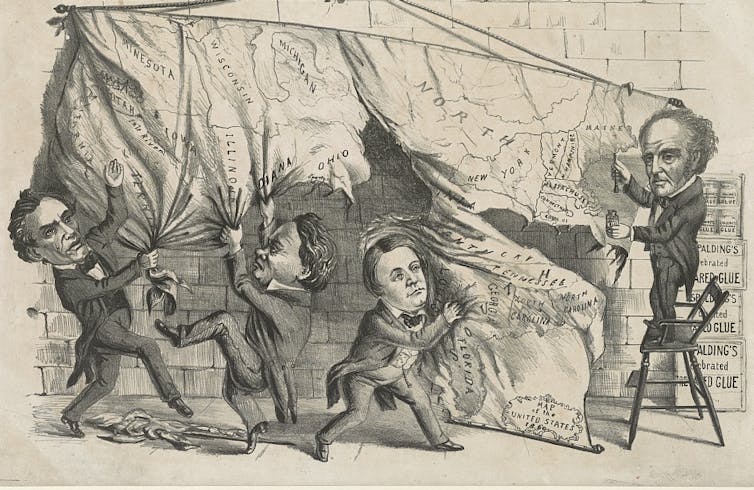
The nation was bitterly divided over slavery in 1860, when this political cartoon was published. Library of Congress Prints and Photographs Division
Bradford Vivian, Pennsylvania State University

The idea of “two Americas,” or “red” and “blue” states, now dominates public discussion. “Political polarization,” the Pew Research Center reports, “is a defining feature of American politics today.”

But the idea that America is politically polarized isn’t new.

In 1858 Abraham Lincoln delivered one of the most important addresses in U.S. history, his “House Divided” speech, when he accepted the Illinois Republican nomination for Senate. The speech marked his entrance into national politics at a time when the nation was profoundly at odds over slavery.

Lincoln’s speech still offers timely lessons about the costs of deep-seated political polarization.

My research examines how communities remember – and sometimes fail to remember – the lessons of the past. Lincoln’s description of the Union as a house divided is well-remembered today. But many Americans fail to heed its deeper lessons about equality and the moral foundations of popular government.

The divided states of America

To cite the language of journalist Bill Bishop’s best-seller, “The Big Sort,” Americans have sorted themselves into distinct, homogeneous groups.

Complex social, moral, legal and even scientific questions are now filtered through the lens of opposing party identifications. Political scientists Daniel Hopkins and John Sides conclude that U.S. “polarization has deep structural and historical roots” with “no easy solutions.”

In his “House Divided” speech, Lincoln addressed a nation even more fiercely divided by partisan acrimony, regional differences and economic tensions than the U.S. of today.

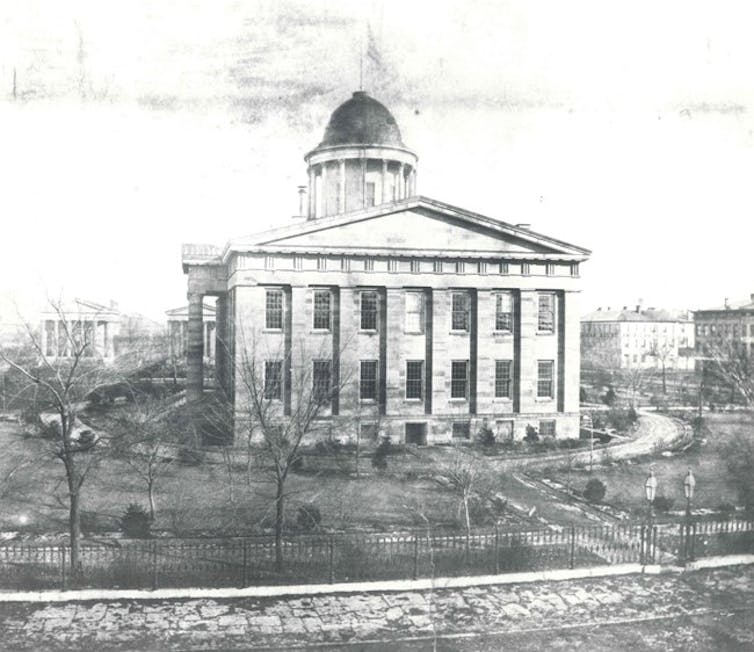
Illinois’ Old State Capitol circa 1858, the year Lincoln gave his ‘House Divided’ speech there. Abraham Lincoln Presidential Library & Museum

Lincoln began his speech by attempting to predict whether a calamity was coming and if it could be prevented:

“If we could first know where we are, and whither we are tending, we could then better judge what to do, and how to do it … I believe this government cannot endure, permanently half slave and half free.”

The alternative to bitter polarization that Lincoln offered didn’t prevent the Civil War. But it shaped postwar understanding of the territorial, political and even armed conflicts that led to it and the lessons to be learned from it.

Union first

Above all, Lincoln stressed in his speech that “a crisis” over slavery was imminent. He asked Americans to choose the common purpose that would best serve their Union – a government of all free or all slave states – before the crisis chose for them.

Lincoln developed the idea that the Union is exceptional in public statements from 1858 until the end of the Civil War. In his First Inaugural in 1861, Lincoln called the Union “perpetual,” and “much older than the Constitution … [N]o State upon its own mere motion can lawfully get out of the Union.” For years, Lincoln held that Americans belong to the Union before they belong to political parties.

His reasoning purposefully echoed George Washington’s Farewell Address of 1796, which warned Americans that “the spirit of party” is a prime threat to “Union … a main prop of your liberty.” For Lincoln, Americans’ common identification with the guiding ideal of equality should transcend their affiliations with political parties.

Consider the symbolism of Lincoln’s main metaphor, the Union as a house:

“A house divided against itself cannot stand …

I do not expect the Union to be dissolved – I do not expect the house to fall – but I do expect it will cease to be divided.”

Building and maintaining a house is familial and collaborative. Family conflicts are inevitable; households fall apart if families don’t resolve those conflicts.

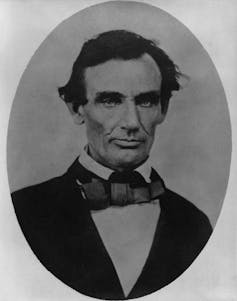
Lincoln in 1858. Shutterstock

The metaphor of a house emphasizes interdependence, cooperation and shared purpose. It asks how citizens might build and maintain something together, despite natural differences, rather than live and work separately.

These ideas have been lost in social and political debates today, which are dominated by competing party agendas and talk of irreconcilable “red” and “blue” state mentalities.

Lincoln’s central warning – “A house divided against itself cannot stand” – was rich in moral significance. A house should rest on a firm physical foundation for the safety of the family who lives in it. The Union, Lincoln implied, should rest on a firm moral foundation: a bedrock dedication to equality.

The Union, he believed, cannot be a compact of convenience or a loose-knit confederation. It was founded for a clear moral purpose: to extend conditions of equality to as many people as possible. The “new nation” that “our fathers brought forth” in 1776, Lincoln would say most memorably in his 1863 Gettysburg Address, was “dedicated to the proposition that all men are created equal.” Commitment to the principle of equality was an essential, not optional, basis of membership within.

Beware false prophets

Bipartisan compromise sounds good – but it can erode fundamental commitments to equality. By 1858, the U.S. had witnessed decades’ worth of political compromises over slavery: the Missouri Compromise of 1820, the Compromise of 1850 and the Kansas-Nebraska Act of 1854. All of these measures maintained the institution of slavery while purporting to limit it.

According to Lincoln, such compromises only led to more intense conflict:

“We are now far into the fifth year, since a policy was initiated, with the avowed object, and confident promise, of putting an end to slavery agitation. Under the operation of that policy, that agitation has not only, not ceased, but has constantly augmented.”

Lincoln warned of false political prophets who earned praise for short-term bipartisan compromises without taking a firm stand on fundamental forms of inequality. They aimed to build a “political dynasty,” not a strong union:

“Our cause, then, must be intrusted to, and conducted by its own undoubted friends – those whose hands are free, whose hearts are in the work – who do care for the result.”

Lincoln’s opponent in the Senate campaign, incumbent Democratic Sen. Stephen A. Douglas, claimed to not care whether territories voted to become free or slave states so long as the elections reflected the popular will in those territories. The “machinery” of such compromises over principles of equality, Lincoln said, constructs only “temporary scaffolding,” hastily fabricated to win elections before being “kicked to the winds.”

Equality over polarization

I believe Lincoln’s “House Divided” speech offers alternative ways to imagine the nation than as a patchwork of “red” and “blue” states.

Americans belong to a union first, parties second. Party machinery and false political prophets divide the house of the people; the people have the power to stabilize that house if they choose to do so. The union was founded on a dedication to equality. It retains a firm moral foundation by preserving commitments to principles of equality over region or party.

The primary offense against the principle of equality in Lincoln’s time was slavery. But Americans can apply the logic of his argument to contemporary inequities based on race, employment, gender, voting rights, criminal justice, religion and more. The nation is a house divided, many times over, in all of those cases.

Lincoln didn’t claim that perfect equality could be achieved. But he saw broad commitments to the idea of equality as essential to the ongoing work of creating, as the Constitution puts it, a more perfect union – and a freer one for all.

The union must “become all one thing, or all the other” in order to be truly free. On this guiding principle, Lincoln declared, there can be no partisan dispute and no bipartisan compromise.

This is an updated version of an article originally published on June 14, 2018.The Conversation

Bradford Vivian, Professor of Communication Arts and Sciences and Director of the Center for Democratic Deliberation, Pennsylvania State University

This article is republished from The Conversation under a Creative Commons license. Read the original article.

Thursday, November 23, 2017

Talking it out, deliberative dialogue in higher education: Compact Nation Podcast

I had the opportunity to be interviewed about my teaching and research with colleagues at Campus Compact as part of #CompactNationPod. Listen below.

Talking it out, deliberative dialogue in higher education

 In our eighth episode of the second season, Co-Hosts Emily Shields and Andrew Seligsohn sat down with author and scholar Timothy Shaffer about his work and research in deliberative dialogue, including his new book “Deliberative Pedagogy: Teaching and Learning for Democratic Engagement.” We discussed what it really takes to embed dialogue in campus and community work and some ideas for making it more effective. We also took a detour from the usual pop culture conversation to review Thanksgiving traditions, including Andrew’s recipe for turkey that doesn’t suck. Listen now and weigh in online using #CompactNationPod.
 

Monday, November 6, 2017

New issue of Journal of Public Deliberation

***Just released!***

This issue features state of the art research on deliberative democracy and public participation in a variety of global contexts. Several articles offer advances in research methods, including John Gastil and colleagues’ assessment of the efficacy of using Participedia as a research tool, and Jaramillo and colleagues’ call for more transparency and data sharing in deliberative research. Research in this issue includes studies of participatory budgeting, stakeholder workshops, focus groups, and youth dialogues in public and university settings. The issue also includes practice-based Reflections from the Field and two book reviews that are likely to be of interest to scholars and practitioners in deliberation and public engagement.

Journal of Public Deliberation,  Volume 13, Issue 2 (Fall 2017)

Table of Contents

Articles
Testing Assumptions in Deliberative Democratic Design: A Preliminary Assessment of the Efficacy of the Participedia Data Archive as an Analytic Tool
John Gastil, Robert C. Richards Jr., Matt Ryan, and Graham Smith

Prompting Deliberation about Nanotechnology: Information, Instruction, and Discussion Effects on Individual Engagement and Knowledge
Lisa M. PytlikZillig, Myiah J. Hutchens, Peter Muhlberger, and Alan J. Tomkins

Beyond Aggregation: “The Wisdom of Crowds” Meets Dialogue in the Case Study of Shaping America’s Youth
Renee G. Heath, Ninon Lewis, Brit Schneider, and Elisa Majors

Explaining Political Efficacy in Deliberative Procedures: A Novel Methodological Approach
Brigitte Geissel and Pamela Hess

The Influence of Communication- and Organization-Related Factors on Interest in Participation in Campus Dialogic Deliberation
Gregory D. Paul

Focus Group Discussion as Sites for Public Deliberation and Sensemaking Following Shared Political Documentary Viewing
Margaret Jane Pitts, Kate Kenski, Stephanie A. Smith, and Corey A. Pavlich

Authority and Deliberative Moments: Assessing Equality and Inequality in Deeply Divided Groups
Rousiley C. M. Maia, Danila Cal, Janine K. R. Bargas, Vanessa V. Oliveira, Patrícia G. C. Rossini, and Rafael C. Sampaio

“Nothing about Politics”: The Political Scope in rural Participatory Governance, A Case Study in the Basque Country, Spain
Patricia García-Espín

Organising Stakeholder Workshops in research and Innovation – Between Theory and Practice
Morten V. Nielsen, Nina Bryndum, and Bjørn Bedsted

Mediation Styles and Participants’ Perception of Success in Consultative Councils: The Case of Guadalajara, Mexico
David López García

 Reflections from the Field
Reading Between the Lines of Participation: Tenant Participation and Participatory Budgeting in Toronto Community Housing
Behrang Foroughi
            
For more Transparency in Deliberative Research: Implications for Deliberative Praxis
Maria Clara Jaramillo, Rousiley C.M. Maia, Simona Mameli, and Jürg Steiner

 Book Reviews
Review of Mere Civility: Disagreement and the Limits of Toleration by Teresa M. Bejan (Cambridge: Harvard University Press, 2017)
Donna Schenck-Hamlin

Review of Listening for Democracy: Recognition, Representation, Reconciliation by Andrew Dobson (New York: Oxford University Press: 2014)
Marietjie Oelofsen

Monday, June 26, 2017

Deliberative Pedagogy - Now on Amazon, B&N, and Google Play

Our book, Deliberative Pedagogy: Teaching and Learning for Democratic Engagement (Michigan State University Press, 2017), is now widely available. You can get it on AmazonBarnes & Noble, and in the Google Play store. As always, you can order it through the MSU Press website. There, use the code "PED2017" for a discount.

We look forward to having people check out the book. And if you happen to read it, please let us know your thoughts and reactions. Public comments are helpful (on Amazon, for example), but you are also encouraged to reach out and email me: tjshaffer [at] ksu.edu.

We published this book because we saw a need for a collection that spoke to the multiple settings in higher education where deliberative approaches to teaching and learning might be useful and impactful. The strength of the book, I think, is the diversity of perspective, place, and institutional type. Here is the blurb from the press about the book:

As the public purposes of higher education are being challenged by the increasing pressures of commodification and market-driven principles, Deliberative Pedagogy argues for colleges and universities to be critical spaces for democratic engagement. The authors build upon contemporary research on participatory approaches to teaching and learning while simultaneously offering a robust introduction to the theory and practice of deliberative pedagogy as a new educational model for civic life. This volume is written for faculty members and academic professionals involved in curricular, co-curricular, and community settings, as well as administrators who seek to support faculty, staff, and students in such efforts. The book begins with a theoretical grounding and historical underpinning of education for democracy, provides a diverse collection of practical case studies with best practices shared by an array of scholars from varying disciplines and institutional contexts worldwide, and concludes with useful methods of assessment and next steps for this work. The contributors seek to catalyze a conversation about the role of deliberation in the next paradigm of teaching and learning in higher education and how it connects with the future of democracy. Ultimately, this book seeks to demonstrate how higher education institutions can cultivate collaborative and engaging learning environments that better address the complex challenges in our global society.

Wednesday, June 14, 2017

"He was a Democrat and I was a Republican so we didn’t have too much to talk about.”

The Belleville-News Democrat, the local paper from the community in which James T. Hodgkinson lived, provides a perspective that I think we need to attend to in the midst of this highly publicized act of violence towards members of Congress and their staff with a gun.

The paper quotes a neighbor of Hodgkinson:
Aaron Meurer is a neighbor of the Hodgkinsons and said he noticed in the last two months James had been gone. The alleged shooter’s wife Suzanne told him her husband was travelling. 
“She said that he went on a trip. She wasn’t real specific,” said Meurer, unclear whether the couple had split up recently.”He’s been gone for the last two months, so I haven’t seen him around too often.” 
Meurer said he occasionally cut his neighbor’s grass to help out. He didn’t know the neighbors well, just socialized from the lawn, and said his neighbor would fire guns on his rural property, commonplace in the open area outside of Belleville. 
“I knew he was a Democrat, a pretty hardcore one. I know he wasn’t happy when Trump got elected but he seemed like a nice enough guy,” recalled Meurer, who said the couple lived across the street for about six years. 
“He seemed like he was sem-retired, he was home a lot. He used to garden a couple of years ago,”said Meurer, who runs his own trimming and removal service. “I didn’t really talk to him too much. He was a Democrat and I was a Republican so we didn’t have too much to talk about.” 
Meurer said during the campaign Hodgkinson had a lone Bernie Sanders sign near the road in his front yard. He thought that Hodgkinson had raised foster kids who had grown up. He also thought there were grandchildren who visited occasionally. 
“We were neighbors but we didn’t talk every day. When we saw them in the yard we’d say 'hi' and go on our way,” said Meurer. “He seemed like a normal guy, a regular guy.” 
Meurer suggested that perhaps “this Democratic rhetoric made him snap. I know he was a pretty hardcore Democrat.”
What is most concerning to me right now, aside from the vast availability of high capacity firearms and this being the 154th mass shooting in 165 days, is the rhetoric we use to speak of our fellow citizens and how we identify so strongly with/against political parties. As Meurer said, “I didn’t really talk to him too much. He was a Democrat and I was a Republican so we didn’t have too much to talk about.” Have we come to a point that we can't share our humanity with someone if they don't share our political affiliation? Disagree passionately. Debate policies. And consider that your view might not be as airtight as you maybe thought. When we demonize the other, we create a space that, with the wrong ingredients, makes members of Congress become targets rather than fellow citizens with differing views.

Art from my mother's college days hanging in my home office. 
The National Institute for Civil Discourse is leading the Revive Civility and Respect campaign and it seems we need to figure out how to engage one another about the significant issues and challenges we face--even when we disagree deeply. We can do this locally. Here in Kansas we organized Kitchen Table Conversations about what it means to be a citizens and a member of a community. A dear friend and colleague in Kentucky inspired me to do this. The point is, we need to be able to talk with neighbors, colleagues, and coworkers about the issues that matter to us. Retreating into enclaves or disconnecting all together can lead people to take detrimental and sometimes deadly action. 

I'm sure I share many of Hodkinsons' frustrations with the current administration, but I know that actions like today only hurt us, not help. After listening to the Speaker of the House and Minority Leader today speak about the day's events, I would love to see a bit of a reset in how we approach our national politics. A serious challenge is that we have made everything partisan. Republican Senate leadership left a seat vacant on the Supreme Court because of partisan politics. We are on the verge of having millions lose health coverage, in part, because the oft-demonized President Obama's name is connected with the otherwise conservative healthcare model we have in the United States. We need better ways to engage, disagree, and deliberate. 

People across the country and the world are watching and listening, taking in the rhetoric and being shaped by the discourse that immerses them. We can do better. We must. We need to have things to talk about with neighbors regardless of which box they marked at the last election.

Wednesday, April 26, 2017

Seeing beyond categories #OpenYourWorld

It's an ad. They want to sell you beer. But it also speaks to the importance of engaging with others as people. We have differences. Sometimes rather significantly. But it helps to be able to recognize and respect the other as much as possible so we can work through those differences.


Thursday, February 9, 2017

Wendell Berry's Questionnaire

Questionnaire

How much poison are you willing
to eat for the success of the free
market and global trade? Please
name your preferred poisons.

For the sake of goodness, how much
evil are you willing to do?
Fill in the following blanks
with the names of your favorite
evils and acts of hatred.

What sacrifices are you prepared
to make for culture and civilization?
Please list the monuments, shrines,
and works of art you would
most willingly destroy.

In the name of patriotism and
the flag, how much of our beloved
land are you willing to desecrate?
List in the following spaces
the mountains, rivers, towns, farms
you could most readily do without.

State briefly the ideas, ideals, or hopes,
the energy sources, the kinds of security;
for which you would kill a child.
Name, please, the children whom
you would be willing to kill.
"Questionnaire" by Wendell Berry from Leavings. © Counterpoint, 2010. (buy now)

Friday, January 20, 2017

In the midst of a new community in the Big Red Barn with Obama

Cornell University's Big Red Barn
In January 2009, I had just started my PhD program at Cornell University. In December 2008, I completed my MPA degree at the University of Dayton and made a winter move to Ithaca, New York. As someone starting an academic program mid-year, I was out of sync with most people. I didn't know others in my program well at that point. Like most of us have experienced some point in our lives, I had a sense of being in the midst of the unknown.

The inauguration of President Obama was a big event. The university had a watch party in the Big Red Barn (BRB), an old carriage house for the university president turned into a graduate student center. It's a great place for various events like the ever-popular T.G.I.F. (Tell Grads It's Friday) with $1 beer and snacks. So, just a few weeks after moving to a new place I was standing in a very crowded BRB watching President Obama be sworn into office for his first term. Many people were emotional. The gravity of the setting and situation spoke to what I recall being a very diverse crowd. What typically was a loud and lively space was celebratory yet solemn that day. I think people realized how significant the moment was for our history and for our future.

I was excited for my own new adventure at Cornell and beyond in the academy, but I was also excited and inspired by the possibility and promise of a democratic life that was/is engaging, meaningful, and inclusive of people from all walks of life and backgrounds. I saw a bit of that diverse America standing in that wonderful gathering place known as the BRB. We would walk out later in our varied directions via snow-worn paths to return to labs, offices, and classrooms. We had a charge and I feel that many people saw themselves as part of something larger that day.

President Obama's inaugural speech acknowledged the many crises we faced at that moment--terror networks, economic catastrophe, rising costs of health care--but he asked us to grow up a bit and choose a better path. In his words:
On this day, we gather because we have chosen hope over fear, unity of purpose over conflict and discord. On this day, we come to proclaim an end to the petty grievances and false promises, the recriminations and worn-out dogmas that for far too long have strangled our politics. We remain a young nation. But in the words of Scripture, the time has come to set aside childish things. The time has come to reaffirm our enduring spirit; to choose our better history; to carry forward that precious gift, that noble idea passed on from generation to generation: the God-given promise that all are equal, all are free, and all deserve a chance to pursue their full measure of happiness.
And what might be more a historical footnote from that day in 2009 is the poem offered by Elizabeth Alexander, entitled Praise Song for the Day. It remains, to me, the most beautiful poem I know. I include it here as people amass in Washington, DC for the inauguration as well as the march to follow the next day. Alexander spoke of possibility and love. We need that more than ever.

Saturday, January 7, 2017

Yes We Can: People Share Their Most Memorable Moments from the Obama Presidency

As President Obama completes his second term, it is helpful to be reminded of the authentic and genuine commitment and compassion that shaped his politics. I don't think the White House will be this warm for a while.