I've watched this short film a few times. I'm a fan of The National. But I feel like this film by Mike Mills made with The National is something more than a long music video.
I've come to experience it as a sort of meditation. You might find it to be useful in such a reflective way for yourself.
Lincoln’s ‘House Divided’ speech teaches important lessons about today's political polarization
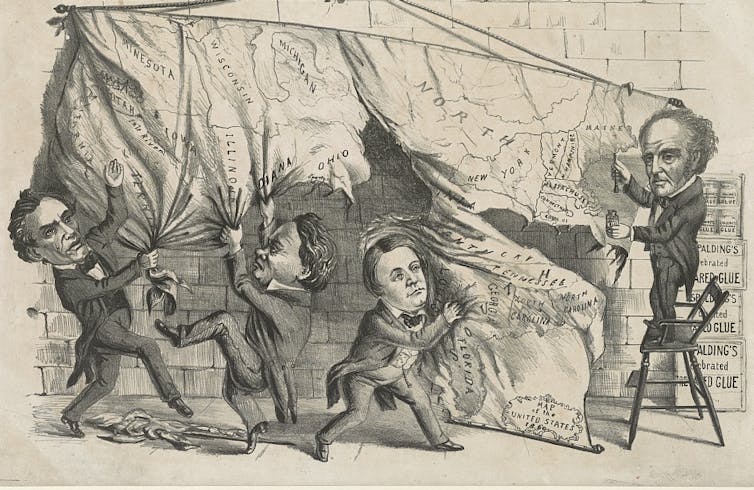
The nation was bitterly divided over slavery in 1860, when this political cartoon was published.
Library of Congress Prints and Photographs DivisionBradford Vivian, Pennsylvania State University
The idea of “two Americas,” or “red” and “blue” states, now dominates public discussion. “Political polarization,” the Pew Research Center reports, “is a defining feature of American politics today.”
But the idea that America is politically polarized isn’t new.
In 1858 Abraham Lincoln delivered one of the most important addresses in U.S. history, his “House Divided” speech, when he accepted the Illinois Republican nomination for Senate. The speech marked his entrance into national politics at a time when the nation was profoundly at odds over slavery.
Lincoln’s speech still offers timely lessons about the costs of deep-seated political polarization.
My research examines how communities remember – and sometimes fail to remember – the lessons of the past. Lincoln’s description of the Union as a house divided is well-remembered today. But many Americans fail to heed its deeper lessons about equality and the moral foundations of popular government.
The divided states of America
To cite the language of journalist Bill Bishop’s best-seller, “The Big Sort,” Americans have sorted themselves into distinct, homogeneous groups.
Complex social, moral, legal and even scientific questions are now filtered through the lens of opposing party identifications. Political scientists Daniel Hopkins and John Sides conclude that U.S. “polarization has deep structural and historical roots” with “no easy solutions.”
In his “House Divided” speech, Lincoln addressed a nation even more fiercely divided by partisan acrimony, regional differences and economic tensions than the U.S. of today.
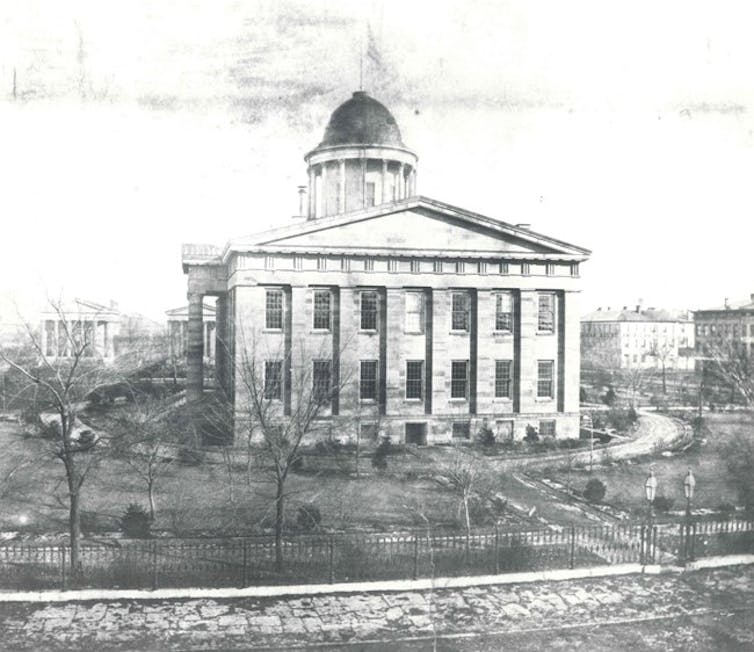
Illinois’ Old State Capitol circa 1858, the year Lincoln gave his ‘House Divided’ speech there.Abraham Lincoln Presidential Library & Museum
Lincoln began his speech by attempting to predict whether a calamity was coming and if it could be prevented:
“If we could first know where we are, and whither we are tending, we could then better judge what to do, and how to do it … I believe this government cannot endure, permanently half slave and half free.”
The alternative to bitter polarization that Lincoln offered didn’t prevent the Civil War. But it shaped postwar understanding of the territorial, political and even armed conflicts that led to it and the lessons to be learned from it.
Union first
Above all, Lincoln stressed in his speech that “a crisis” over slavery was imminent. He asked Americans to choose the common purpose that would best serve their Union – a government of all free or all slave states – before the crisis chose for them.
Lincoln developed the idea that the Union is exceptional in public statements from 1858 until the end of the Civil War. In his First Inaugural in 1861, Lincoln called the Union “perpetual,” and “much older than the Constitution … [N]o State upon its own mere motion can lawfully get out of the Union.” For years, Lincoln held that Americans belong to the Union before they belong to political parties.
His reasoning purposefully echoed George Washington’s Farewell Address of 1796, which warned Americans that “the spirit of party” is a prime threat to “Union … a main prop of your liberty.” For Lincoln, Americans’ common identification with the guiding ideal of equality should transcend their affiliations with political parties.
Consider the symbolism of Lincoln’s main metaphor, the Union as a house:
“A house divided against itself cannot stand …
I do not expect the Union to be dissolved – I do not expect the house to fall – but I do expect it will cease to be divided.”
Building and maintaining a house is familial and collaborative. Family conflicts are inevitable; households fall apart if families don’t resolve those conflicts.
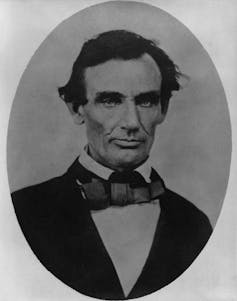
Lincoln in 1858.Shutterstock
The metaphor of a house emphasizes interdependence, cooperation and shared purpose. It asks how citizens might build and maintain something together, despite natural differences, rather than live and work separately.
These ideas have been lost in social and political debates today, which are dominated by competing party agendas and talk of irreconcilable “red” and “blue” state mentalities.
Lincoln’s central warning – “A house divided against itself cannot stand” – was rich in moral significance. A house should rest on a firm physical foundation for the safety of the family who lives in it. The Union, Lincoln implied, should rest on a firm moral foundation: a bedrock dedication to equality.
The Union, he believed, cannot be a compact of convenience or a loose-knit confederation. It was founded for a clear moral purpose: to extend conditions of equality to as many people as possible. The “new nation” that “our fathers brought forth” in 1776, Lincoln would say most memorably in his 1863 Gettysburg Address, was “dedicated to the proposition that all men are created equal.” Commitment to the principle of equality was an essential, not optional, basis of membership within.
Beware false prophets
Bipartisan compromise sounds good – but it can erode fundamental commitments to equality. By 1858, the U.S. had witnessed decades’ worth of political compromises over slavery: the Missouri Compromise of 1820, the Compromise of 1850 and the Kansas-Nebraska Act of 1854. All of these measures maintained the institution of slavery while purporting to limit it.
According to Lincoln, such compromises only led to more intense conflict:
“We are now far into the fifth year, since a policy was initiated, with the avowed object, and confident promise, of putting an end to slavery agitation. Under the operation of that policy, that agitation has not only, not ceased, but has constantly augmented.”
Lincoln warned of false political prophets who earned praise for short-term bipartisan compromises without taking a firm stand on fundamental forms of inequality. They aimed to build a “political dynasty,” not a strong union:
“Our cause, then, must be intrusted to, and conducted by its own undoubted friends – those whose hands are free, whose hearts are in the work – who do care for the result.”
Lincoln’s opponent in the Senate campaign, incumbent Democratic Sen. Stephen A. Douglas, claimed to not care whether territories voted to become free or slave states so long as the elections reflected the popular will in those territories. The “machinery” of such compromises over principles of equality, Lincoln said, constructs only “temporary scaffolding,” hastily fabricated to win elections before being “kicked to the winds.”
Equality over polarization
I believe Lincoln’s “House Divided” speech offers alternative ways to imagine the nation than as a patchwork of “red” and “blue” states.
Americans belong to a union first, parties second. Party machinery and false political prophets divide the house of the people; the people have the power to stabilize that house if they choose to do so. The union was founded on a dedication to equality. It retains a firm moral foundation by preserving commitments to principles of equality over region or party.
The primary offense against the principle of equality in Lincoln’s time was slavery. But Americans can apply the logic of his argument to contemporary inequities based on race, employment, gender, voting rights, criminal justice, religion and more. The nation is a house divided, many times over, in all of those cases.
Lincoln didn’t claim that perfect equality could be achieved. But he saw broad commitments to the idea of equality as essential to the ongoing work of creating, as the Constitution puts it, a more perfect union – and a freer one for all.
The union must “become all one thing, or all the other” in order to be truly free. On this guiding principle, Lincoln declared, there can be no partisan dispute and no bipartisan compromise.
This is an updated version of an article originally published on June 14, 2018.
I had the opportunity to be interviewed about my teaching and research with colleagues at Campus Compact as part of #CompactNationPod. Listen below.
Talking it out, deliberative dialogue in higher education
In our eighth episode of the second season, Co-Hosts Emily Shields and Andrew Seligsohn sat down with author and scholar Timothy Shaffer about his work and research in deliberative dialogue, including his new book “Deliberative Pedagogy: Teaching and Learning for Democratic Engagement.” We discussed what it really takes to embed dialogue in campus and community work and some ideas for making it more effective. We also took a detour from the usual pop culture conversation to review Thanksgiving traditions, including Andrew’s recipe for turkey that doesn’t suck. Listen now and weigh in online using #CompactNationPod.
This issue features state of the art research on deliberative democracy and public participation in a variety of global contexts. Several articles offer advances in research methods, including John Gastil and colleagues’ assessment of the efficacy of using Participedia as a research tool, and Jaramillo and colleagues’ call for more transparency and data sharing in deliberative research. Research in this issue includes studies of participatory budgeting, stakeholder workshops, focus groups, and youth dialogues in public and university settings. The issue also includes practice-based Reflections from the Field and two book reviews that are likely to be of interest to scholars and practitioners in deliberation and public engagement.
Journal of Public Deliberation, Volume 13, Issue 2 (Fall 2017)
Our book, Deliberative Pedagogy: Teaching and Learning for Democratic Engagement (Michigan State University Press, 2017), is now widely available. You can get it on Amazon, Barnes & Noble, and in the Google Play store. As always, you can order it through the MSU Press website. There, use the code "PED2017" for a discount. We look forward to having people check out the book. And if you happen to read it, please let us know your thoughts and reactions. Public comments are helpful (on Amazon, for example), but you are also encouraged to reach out and email me: tjshaffer [at] ksu.edu. We published this book because we saw a need for a collection that spoke to the multiple settings in higher education where deliberative approaches to teaching and learning might be useful and impactful. The strength of the book, I think, is the diversity of perspective, place, and institutional type. Here is the blurb from the press about the book:
As the public purposes of higher education are being challenged by the increasing pressures of commodification and market-driven principles, Deliberative Pedagogy argues for colleges and universities to be critical spaces for democratic engagement. The authors build upon contemporary research on participatory approaches to teaching and learning while simultaneously offering a robust introduction to the theory and practice of deliberative pedagogy as a new educational model for civic life. This volume is written for faculty members and academic professionals involved in curricular, co-curricular, and community settings, as well as administrators who seek to support faculty, staff, and students in such efforts. The book begins with a theoretical grounding and historical underpinning of education for democracy, provides a diverse collection of practical case studies with best practices shared by an array of scholars from varying disciplines and institutional contexts worldwide, and concludes with useful methods of assessment and next steps for this work. The contributors seek to catalyze a conversation about the role of deliberation in the next paradigm of teaching and learning in higher education and how it connects with the future of democracy. Ultimately, this book seeks to demonstrate how higher education institutions can cultivate collaborative and engaging learning environments that better address the complex challenges in our global society.
The Belleville-News Democrat, the local paper from the community in which James T. Hodgkinson lived, provides a perspective that I think we need to attend to in the midst of this highly publicized act of violence towards members of Congress and their staff with a gun.
Aaron Meurer is a neighbor of the Hodgkinsons and said he noticed in the last two months James had been gone. The alleged shooter’s wife Suzanne told him her husband was travelling.
“She said that he went on a trip. She wasn’t real specific,” said Meurer, unclear whether the couple had split up recently.”He’s been gone for the last two months, so I haven’t seen him around too often.”
Meurer said he occasionally cut his neighbor’s grass to help out. He didn’t know the neighbors well, just socialized from the lawn, and said his neighbor would fire guns on his rural property, commonplace in the open area outside of Belleville.
“I knew he was a Democrat, a pretty hardcore one. I know he wasn’t happy when Trump got elected but he seemed like a nice enough guy,” recalled Meurer, who said the couple lived across the street for about six years.
“He seemed like he was sem-retired, he was home a lot. He used to garden a couple of years ago,”said Meurer, who runs his own trimming and removal service. “I didn’t really talk to him too much. He was a Democrat and I was a Republican so we didn’t have too much to talk about.”
Meurer said during the campaign Hodgkinson had a lone Bernie Sanders sign near the road in his front yard. He thought that Hodgkinson had raised foster kids who had grown up. He also thought there were grandchildren who visited occasionally.
“We were neighbors but we didn’t talk every day. When we saw them in the yard we’d say 'hi' and go on our way,” said Meurer. “He seemed like a normal guy, a regular guy.”
Meurer suggested that perhaps “this Democratic rhetoric made him snap. I know he was a pretty hardcore Democrat.”
What is most concerning to me right now, aside from the vast availability of high capacity firearms and this being the 154th mass shooting in 165 days, is the rhetoric we use to speak of our fellow citizens and how we identify so strongly with/against political parties. As Meurer said, “I didn’t really talk to him too much. He was a Democrat and I was a Republican so we didn’t have too much to talk about.” Have we come to a point that we can't share our humanity with someone if they don't share our political affiliation? Disagree passionately. Debate policies. And consider that your view might not be as airtight as you maybe thought. When we demonize the other, we create a space that, with the wrong ingredients, makes members of Congress become targets rather than fellow citizens with differing views.
Art from my mother's college days hanging in my home office.
The National Institute for Civil Discourse is leading the Revive Civility and Respect campaign and it seems we need to figure out how to engage one another about the significant issues and challenges we face--even when we disagree deeply. We can do this locally. Here in Kansas we organized Kitchen Table Conversations about what it means to be a citizens and a member of a community. A dear friend and colleague in Kentucky inspired me to do this. The point is, we need to be able to talk with neighbors, colleagues, and coworkers about the issues that matter to us. Retreating into enclaves or disconnecting all together can lead people to take detrimental and sometimes deadly action.
I'm sure I share many of Hodkinsons' frustrations with the current administration, but I know that actions like today only hurt us, not help. After listening to the Speaker of the House and Minority Leader today speak about the day's events, I would love to see a bit of a reset in how we approach our national politics. A serious challenge is that we have made everything partisan. Republican Senate leadership left a seat vacant on the Supreme Court because of partisan politics. We are on the verge of having millions lose health coverage, in part, because the oft-demonized President Obama's name is connected with the otherwise conservative healthcare model we have in the United States. We need better ways to engage, disagree, and deliberate.
People across the country and the world are watching and listening, taking in the rhetoric and being shaped by the discourse that immerses them. We can do better. We must. We need to have things to talk about with neighbors regardless of which box they marked at the last election.